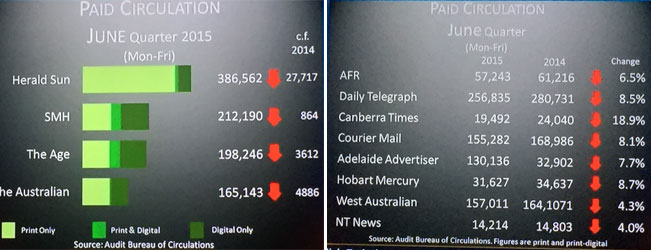
The latest newspaper circulation figures for Australian media organisations make for more sorry reading. Every title, no matter how they try to dress it up (and, boy, have they tried) is in the red, as the graphic above shows (courtesy: ABC News).
Fairfax media seem to have totally given up on print’s future, calling the newspaper circ numbers a “historical production metric” (translation: they are so bad, we are not going to pay much attention to them anymore, in fact, they are a thing of history).
The bright side in all this is the growth in digital subscriptions to newspapers… err, sorry, media organisations.
‘Digital only’ paid subscriptions to the Sydney Morning Herald and The Age now surpass the ‘print and digital’ offer (interesting) and are almost as large as the ‘print only’. Total subscriptions though are well down, although the pace of decline has slowed.
Even our local print monopolist, the West Australian (apparently the most expensive, and best performing daily in the country) has seen subscriptions fall another 4.3%.
The Fin Review has (so I am told) 15,000 digital subscribers (not many for a national product) and the Australian around 55,000. Meanwhile, the Financial Times has 700,000+ print/digital subscribers around the globe, 70% of them are digital mix or digital only. The New York Times has 800,000 subscribers, and a team of 300+ staff to manage them.
A migration to digital platforms is now gathering pace. People who want quality news, specialised news, niche news, are increasingly OK with paying for it. Most people get their general news from free web sites, TV news broadcasts and (increasingly) Facebook feeds (i.e. the news that friends of theirs post daily). Facebook has even begun experimenting with its own Facebook news product (‘Instant Articles‘), so publishers can post directly onto newsfeeds of its 1.1billion or so users.
This major ‘print to digital’ trend is now the main game in news media organisations, and within digital (now the largest media category) there is a move to social and mobile.
Will print die? Interestingly, some commentators think it might still have a role ‘in the mix’. Albeit a smaller one.
When a wily investor like Warren Buffet forks out US$344 million for 28 local newspapers in the States (in 2013), then you know there is something of value still there. His reasons for this included the power local papers have to disseminate news to a community, who, bored of the depressing nature of the global news, turn to something they are a part of, and can understand. Newspaper organisations with a ‘sensible Internet strategy’ will do the best and can still make good earnings.
We live in interesting times.